The origin of pollen tube growth innovations in flowering plants:
Our studies of pollen tube growth patterns in a number of ancient angiosperm lineages indicate that pollen tube growth rate innovations were an important aspect of early angiosperm reproduction, and may also have enabled a host of other reproductive novelties to evolve. Pollen tubes of early-divergent angiosperms, such as Amborella, Trithuria, Nymphaea, Austrobaileya, Hedyosmum and others, all have similar structural features, the most conspicuous of which are callose tube walls, callose plugs and very thin pectic tips. Gymnosperm pollen tubes are quite different in structure and do not grow fast or far. Early angiosperm pollen tubes have faster growth rates than any gymnosperm pollen tube, and the origin of faster growth rates has been followed by the repeated evolution of long-distance growth and orders of magnitude faster growth rates in derived lineages. The structural characteristics of pollen tubes preceded, and may have been a necessary prerequisite for the origin of carpel closure itself. Stylar elongation, ovary elongation and extreme life history acceleration are also important innovations that arose later, and could not have arisen without the prior origin of the angiosperm pollen tube growth pattern.
Given the importance of pollen tube growth rate in flowering plant evolution, we are studying sources of ontogenetic and life history variation in pollen tube growth rates across a number of early-divergent angiosperms. How did early angiosperms evolve faster pollen tube growth rates (tip extension) than gymnosperms, and what are the limitations or pathways that prevented or enabled such rates to evolve? A major aspect of these studies is to determine the relationship between rates of pollen tube wall production and the rate of tip extension. What are the factors that are involved in modulating the rate at which the sperm are carried from stigma to egg? Two alternative answers, based on comparisons between many species (there is no data yet on any one species), are: 1) rate varies because different species use greater or smaller amounts or types of wall material to extend their tips, or 2) rate varies because the rate of wall synthesis varies. The former is a conservative mechanism of evolution (streamlining of resources), whereas the latter involves changes (increases) in pollen tube metabolic rate. One expectation is that pollen tube growth rate variation in early-divergent angiosperms will have a lot to do with dimensional evolution of pollen tubes, whereas big increases in metabolic rates will predominate in later lineages. This is because sporophyte metabolic rates are relatively low in these groups, with the exception of early lineages that moved into resource-rich environments, such as aquatics and some sun-adapted vines. I am collaborating with Dr. Taylor Feild and Dr. Brian O'Meara on comparative aspects of these questions.
Another aspect of this project is to understand the evolution of genes that underlie the pollen tube wall phenotype. We have hypothesized that gene duplication played a significant role in the origin of angiosperm pollen tube growth, at the structural and/or the regulatory gene level, and hence in the adaptive radiation of flowering plants. The synthesis of callose, the main structural component of the angiosperm pollen tube wall, is catalyzed by the callose synthase gene, CalS. Dr. Jason Abercrombie, a postdoc in the lab, used bioinformatic and RT-PCR approaches to identify orthologous and paralogous CalS genes from pollen and pollen tubes of non-flowering seed plants, Ginkgo, Gnetum, Pinus, and a number of basal angiosperms such as Amborella, Trithuria, Cabomba, Nymphaea, Nuphar, Austrobaileya and several others. The CalS gene family has 12 members in Arabidopsis but only the CalS5 gene copy is involved in producing pollen tube callose. What is the origin of CalS5 and its strong expression pattern in angiosperm pollen tubes? Callose expression is highly variable among non-flowering plant pollen tubes, but rarely is seen as the main component of their pollen tube wall. Dr. Abercrombie looked at at expression patterns of CalS genes in these species and found that CalS-5 is not a unique angiosperm duplicated gene - it is a more ancient gene that is expressed in pollen of Gingko, Zamia and Gnetum. Therefore, it must have undergone substantial regulatory evolution before or in early angiosperm history. Currently, we are looking at pectin methyl esterase gene (PME) expression in these same taxa. PME and its inhibitors also contributes to strengthening of the lateral tube walls of the pollen tube.
This project is currently supported by NSF.
Alapo, L. 2016. UT's Williams co-edits Journal exploring latest research on pollen performance. Tennessee Today April 8, 2016. See article
Hund, R. 2016. UT's Small but not forgotten: New ideas on pollen's ecology and evolution. EurekAlert April 4, 2016. See article
Hund, R. 2014. Which came first, bi- or tricellular pollen? New research updates a classic debate. EurekAlert May 2, 2014. See article
Mayfield, J. 2009. Flora in Excelsis. Quest (Research magazine of University of Tennessee) 1(2): 8-11. See article
Bosveld, J. 2009. Speedy sperm explains flower power (Top 100 science stories of 2008, number 87). Discover magazine January issue, page 69. See article
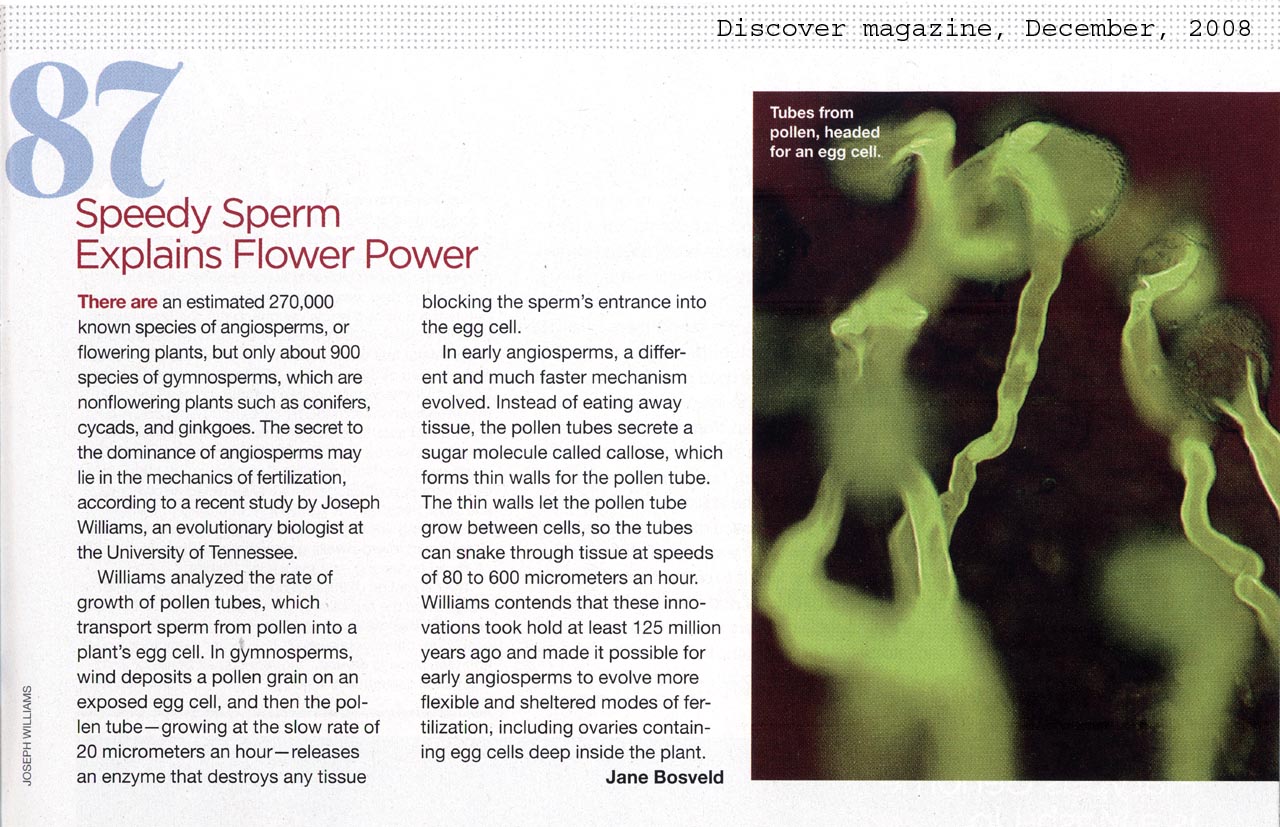
Smith, W. 2009. Darwin would be proud. Bearden/Cedar Bluff Shopper-News Now January 19, 2009, page A-5. See article
Carlson, E. 2009. Professor's research receives honor. The Daily Beacon (University of Tennessee) 1/9/09. See article
Williams, R. D. 2008. Discover magazine honors UT professor. Knoxville News Sentinel 12/26/08. See article
Minas Gerais TV Rede Integração. 2008. Espécie rara de árvore de 125 milhões de anos é encontrada no Cerrado. Interview in Portuguese from local TV in Uberlandia, Brasil. See article
University of Tennessee internal publicity
Manjimup Times (Western Australia) article on Mackenzie Taylor's fieldwork, December, 2008. See article
Mate recognition in early lineages of angiosperms:
Most aspects of mate recognition systems cannot be studied in the fossil record. However, there are conspicuous differences between extant gymnosperm and angiosperm lineages with regards to mate recognition. Extant gymnosperms generally do not have pre-fertilization mate recognition, whereas angiosperms generally have varying degrees of both pre- and post-fertilization mate recognition. What kinds of developmental transitions accompanied the origin of pre-fertilization mate recognition in angiosperms? I am addressing this question by studying pre-fertilization mate recognition processes in newly-defined early lineages of angiosperms, focusing initially on self vs. outcross recognition. Because mating systems in plants are mediated by development, not behavior (as in animals), study of mating system evolution is inherently a study of the evolution of development. My lab is undertaking a variety of studies on early lineages of angiosperms, starting with the question of the nature of self versus outcross ontogenies during the progamic phase, the life history period between pollination and fertilization. Mating systems can be strongly influenced by two types of post-pollination processes: competition among male gametophytes and/or differential attrition of male gametophytes. I am currently focusing on Austrobaileya scandens, a vine endemic to the wet tropics region of northeastern Queensland, Australia. Graduate students, Mackenzie Taylor and Nick Buckley are working on their dissertations within the Nymphaeales and Austrobaileyales, respectively. These are two ancient angiosperm lineages in which most species have bisexual flowers, and hence may offer insights into the early evolution of post-pollination inbreeding avoidance.
This project was supported by NSF.
Phylogeography of Austrobaileya scandens:
In collaboration with Andrew Ford (CSIRO,